Resources for Teaching and Learning
The Ringer: Bad News, Gumshoes: Carmen Sandiego Is No Longer a Villain - Yes, the geography educating villain that came from a computer game and then on to PBS has returned on Netflix - as a hero.
PostGIS: The “Intro to PostGIS” workshop lives here now. Apparently, that's a new home. Via @postgis.
Showing posts with label AAG. Show all posts
Thursday, January 24, 2019
Thursday, December 6, 2018
GIS Education Weekly: Underrated Colleges Have Winning Geographies
Course and Classroom Resources
Sydney Morning Herald: Where you live is determining your school's NAPLAN score - "In a new analysis, Macquarie University researchers have found that the area in which a student goes to school is one of the clearest predictors of year 5 NAPLAN reading scores, painting a stark picture of Australia's socioeducational divide."
Habitat Seven: The Climate Explorer - Explore graphs and maps of historical and projected climate variables for any county in the contiguous United States. "The Climate Explorer is a web application offering interactive maps and graphs to assist users in decision-making and resilience-building contexts. Built to support the U.S. Climate Resilience Toolkit, the Climate Explorer helps people explore the exposure of human populations and valued assets to climate-related hazards that may put those assets at risk."
Sydney Morning Herald: Where you live is determining your school's NAPLAN score - "In a new analysis, Macquarie University researchers have found that the area in which a student goes to school is one of the clearest predictors of year 5 NAPLAN reading scores, painting a stark picture of Australia's socioeducational divide."
Thursday, June 29, 2017
GIS Education Weekly: Google Earth, ArcGIS Pro and Coloring in the Curriculum
Resources and Articles
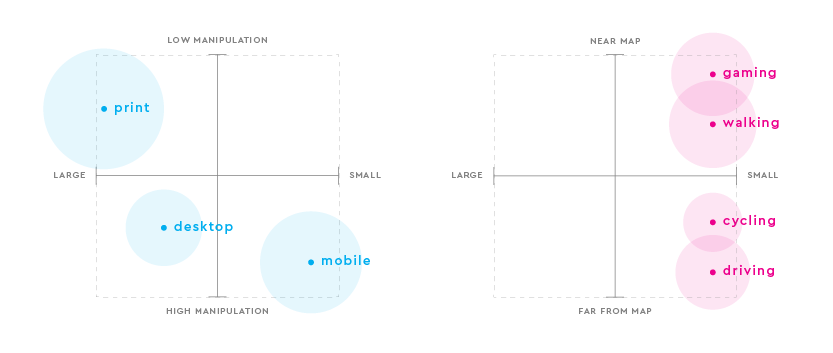
Mapbox Blog: Designing maps for mobile devices - Nathaniel Slaughter explores how to think about map scale, map size and the user's motion to make fit for purpose visualizations. As Bill Morris (@vtcraghead) pointed out on Twitter, the graphic at right is a keeper.
Integrating ArcGIS Pro & Web Mapping in the Cartography Curriculum
Monica Lloyd of Centre of Geographic Sciences (COGS, NS, Canada) offers a story map on the topic.
Mapbox Blog: Designing maps for mobile devices - Nathaniel Slaughter explores how to think about map scale, map size and the user's motion to make fit for purpose visualizations. As Bill Morris (@vtcraghead) pointed out on Twitter, the graphic at right is a keeper.
![]() |
| Map Size and Interactivity Levels |
Monica Lloyd of Centre of Geographic Sciences (COGS, NS, Canada) offers a story map on the topic.
Thursday, September 15, 2016
GIS Education Weekly: World's Largest Lesson focusses on Sustainability, Global Literacy Survey has Bad News
Programs, Degrees and Courses
Delta State University has a new program, I'm not sure of the name, but it's in partnership with the United States Marine Corps. The program was a major force behind the development and accreditation of a new degree, a Bachelor of Applied Science in Geospatial Analysis and Intelligence.
Penn State's Maps and the Geospatial Revolution MOOC begins its 4th offering beginning Sept 10. Registration is open until Sept 15. The course was updated to the "new" course vision for Coursera: "Each course is like an interactive textbook, featuring pre-recorded videos, quizzes and projects."
Delta State University has a new program, I'm not sure of the name, but it's in partnership with the United States Marine Corps. The program was a major force behind the development and accreditation of a new degree, a Bachelor of Applied Science in Geospatial Analysis and Intelligence.
Penn State's Maps and the Geospatial Revolution MOOC begins its 4th offering beginning Sept 10. Registration is open until Sept 15. The course was updated to the "new" course vision for Coursera: "Each course is like an interactive textbook, featuring pre-recorded videos, quizzes and projects."
Thursday, July 28, 2016
GIS Education Weekly: AP GIS&T Proposal and a Spatial Center at the University of Chicago
AAG Proposes AP GIS&T Course
The AAG has issued a proposal for a new Advanced Placement course in Geographic Information Science and Technology (AP GIS&T). It's soliciting "attestations" from U.S. high schools, colleges, and universities. For the course to become reality, 250 high schools need to sign on confirming interest and capacity to teach it and 100 colleges and universities have to be willing to offer some sort of credit to students who score high enough on the exam. The commitments are due by October 1. There's a list of endorsing organizations (as of July 22) in this PDF.
Also in my feed this week, from The Atlantic: It turns out that students who take AP classes don’t actually get better college grades.
Research News
The National Center for Research in Geography Education (NCRGE), a research coordination network funded by the NSF, announced the first recipients of its Transformative Research grant program. The three groups will be represented at the NCGE conference in Tampa on Saturday, July 30 in a session from 11:00 am – 12:15 pm. They'll also be at a symposium planned for the 2017 AAG Annual Meeting in Boston on Saturday, April 8, 2017. The topics of the grants are assessment, learning progressions and problem based learning. The AAG symposium will feature guest speakers, paper and panel sessions, and grant-writing workshops for geography education research.
The AAG has issued a proposal for a new Advanced Placement course in Geographic Information Science and Technology (AP GIS&T). It's soliciting "attestations" from U.S. high schools, colleges, and universities. For the course to become reality, 250 high schools need to sign on confirming interest and capacity to teach it and 100 colleges and universities have to be willing to offer some sort of credit to students who score high enough on the exam. The commitments are due by October 1. There's a list of endorsing organizations (as of July 22) in this PDF.
Also in my feed this week, from The Atlantic: It turns out that students who take AP classes don’t actually get better college grades.
Research News
The National Center for Research in Geography Education (NCRGE), a research coordination network funded by the NSF, announced the first recipients of its Transformative Research grant program. The three groups will be represented at the NCGE conference in Tampa on Saturday, July 30 in a session from 11:00 am – 12:15 pm. They'll also be at a symposium planned for the 2017 AAG Annual Meeting in Boston on Saturday, April 8, 2017. The topics of the grants are assessment, learning progressions and problem based learning. The AAG symposium will feature guest speakers, paper and panel sessions, and grant-writing workshops for geography education research.
Thursday, May 26, 2016
GIS Education News: UC Davis Coursera Specialization Update
UC Davis Specialization Update
The UC Davis GIS specialization, hosted on Coursera, includes five courses, two of which are now live. The third course, Geospatial and Environmental Analysis, is expected to launch in the next few weeks. I wrote about the specialization back in January; the first course launched in February.
The first two courses are getting positive reviews. I found this recap of the first course, Fundamentals of GIS, by someone named William. That course gets a high score on Coursera: "4.8 out of 5 of 229 ratings." The second course, GIS Data Formats, Design and Quality, gets the same 4.8 score based on 51 ratings, as I write this.
I contacted Nick Santos, the lead course developer and instructor, to get his perspective on the first few months of the specialization. He explained that "the vast majority of students continue to get access to the courses for free" while "enough students are paying for the courses and specialization" to defray the significant development costs.
The monthly offerings have allowed him to identify "the common questions - both ones because of errors or inadequacies in the materials as well as ones related to language barrier, and diversity of student backgrounds." He's put together an FAQ to address them. Santos is looking forward to completing course development so he can spend more time interacting with the students.
He's already updated both the final assignment and its assessment method for the second course. He's pleased with immediacy and flexibility of teaching via Coursera: "The thing I really like about this platform is that we can constantly make changes, so when I see an issue with the course, I can update the materials and students get the new materials right away."
Subscribe!
Subscribe! Get this GIS education update free, via e-mail, every Thursday! Last week's issue had three times the normal readership. Thanks for sharing!
The UC Davis GIS specialization, hosted on Coursera, includes five courses, two of which are now live. The third course, Geospatial and Environmental Analysis, is expected to launch in the next few weeks. I wrote about the specialization back in January; the first course launched in February.
The first two courses are getting positive reviews. I found this recap of the first course, Fundamentals of GIS, by someone named William. That course gets a high score on Coursera: "4.8 out of 5 of 229 ratings." The second course, GIS Data Formats, Design and Quality, gets the same 4.8 score based on 51 ratings, as I write this.
I contacted Nick Santos, the lead course developer and instructor, to get his perspective on the first few months of the specialization. He explained that "the vast majority of students continue to get access to the courses for free" while "enough students are paying for the courses and specialization" to defray the significant development costs.
The monthly offerings have allowed him to identify "the common questions - both ones because of errors or inadequacies in the materials as well as ones related to language barrier, and diversity of student backgrounds." He's put together an FAQ to address them. Santos is looking forward to completing course development so he can spend more time interacting with the students.
He's already updated both the final assignment and its assessment method for the second course. He's pleased with immediacy and flexibility of teaching via Coursera: "The thing I really like about this platform is that we can constantly make changes, so when I see an issue with the course, I can update the materials and students get the new materials right away."
Subscribe!
Subscribe! Get this GIS education update free, via e-mail, every Thursday! Last week's issue had three times the normal readership. Thanks for sharing!
Thursday, March 17, 2016
GIS Education Weekly: Geography Departments Change Names, Mapathons for Everyone
Grand Valley State Geography Department adds Sustainability
Grand Valley State in Allendale, MI will change the name and focus of its geography department.
MSU Adds Environment to its Department Name
Michigan State University's geography department has also been working to change its name. As of July 1, it'll officially be the Department of Geography, Environment, and Spatial Sciences. More details are in the Spartan Geographer newsletter (pdf).
Subscribe!
Get this GIS education update free, via e-mail, every Thursday.
Grand Valley State in Allendale, MI will change the name and focus of its geography department.
The department will now be called the geography and sustainable planning department and will incorporate over 20 courses concerning sustainability.
Elena Lioubimtseva, chair of the department, said the program offers the integration of economic development, social priorities, place-based problem solving as well as the international connection of all elements of geography. The program will also cover the solutions and adaptations to global issues such as climate change.I'm seeing sustainability mentioned formally and informally alongside GIS in many universities. I think the association can only help grow geography. Geography associating itself with STEM in K-12 and higher education may have a similar effect.
MSU Adds Environment to its Department Name
Michigan State University's geography department has also been working to change its name. As of July 1, it'll officially be the Department of Geography, Environment, and Spatial Sciences. More details are in the Spartan Geographer newsletter (pdf).
Subscribe!
Get this GIS education update free, via e-mail, every Thursday.
Thursday, January 7, 2016
GIS Education Weekly: New Year, New Names
Where in the World?
To celebrate the 20th anniversary of its first airing People Magazine shares 10 Reasons Where in the World Is Carmen Sandiego? Was the Best Educational TV Show Ever. Yes, I was a fan and became a bigger fan of Rockapella as the years passed.
![]() |
| Cast photo, season four via Wikipedia |
Names Change
This discussion of seven public places in American that were renamed to be more "hospitable" in 2015 is an interesting topic for students.
Labels:
AAG,
cartography,
certificate,
geography,
weekly
Monday, November 2, 2015
Call for Papers....Deadline Extended!
Labels:
AAG,
conference,
esriuc
Monday, October 26, 2015
What the GAO Report on Geography Really Says
K-12 EDUCATION: Most Eighth Grade Students Are Not Proficient in Geography
Last week the Government Accountability Office (GAO) published a report titled K-12 EDUCATION: Most Eighth Grade Students Are Not Proficient in Geography (pdf). I read it this weekend. Here's a recap.
Why the report?
The Senate asked the GAO to report on the status of geography education and challenges elementary and secondary schools face in providing that education with limited resources.
What did the GAO do?
The GAO examined:
- eighth grade geography proficiency
- challenges some school officials and teachers face in teaching geography
- the role of the Department of Education in geography education
Labels:
AAG,
gao,
geography education,
ncge,
report
Tuesday, May 26, 2015
Potential AP GIS&T Course: Thinking Out Loud
The Association of American Geographers (AAG) has posted a request to identify educators and others who want to work on a proposal for a new high school Advanced Placement course in Geographic Information Science and Technology (GIS&T).
The original request came from the College Board to the Geography Education National Implementation Project (GENIP), a coordinating committee with representatives from the AAG, National Geographic Society, the National Council for Geographic Education, and the American Geographical Society. GENIP already overseas the Advanced Placement Human Geography and Geography Standards initiatives. AAG is taking the lead in organizing a response for the GIS&T course.
I've been rolling the idea around it my head: Is an AP GIS&T course a good idea? Will it help GIS&T grow in academia, research and the marketplace? I've not come to any conclusions, but below I share some thoughts and questions.
The original request came from the College Board to the Geography Education National Implementation Project (GENIP), a coordinating committee with representatives from the AAG, National Geographic Society, the National Council for Geographic Education, and the American Geographical Society. GENIP already overseas the Advanced Placement Human Geography and Geography Standards initiatives. AAG is taking the lead in organizing a response for the GIS&T course.
I've been rolling the idea around it my head: Is an AP GIS&T course a good idea? Will it help GIS&T grow in academia, research and the marketplace? I've not come to any conclusions, but below I share some thoughts and questions.
Labels:
AAG,
ap gis&t,
college board,
genip,
geospatial semester
Monday, May 18, 2015
Rethinking the Poster Session
Some Anecdotes
A few weeks ago I heard a disheartened geographer bemoan his poster experience at the AAG annual meeting in Chicago. It sounds like it was a pain to get the poster up on time, be available during the many hours it was to be shown, then take it down. I got the sense the presenter was disappointed there was so little interaction between the poster presenters and attendees.
Two weeks ago I attended the Tufts Ninth Annual GIS Poster Exposition in Medford, Massachusetts. About 150 student and faculty posters were crammed into a space on campus for two hours. Most were traditional foam core poster boards, but a handful were "apps," including at least one story map. The venue was loud and packed with people talking to one another and eating the snacks. The authors did not present, nor stand with, their posters. I overheard a woman, who I identified as a student, note that her poster probably had too much text. You could pick out the student posters; they had the misspellings and cartographic "room for improvement" you'd expect of first time and less experienced mappers. Toward the end of the event, organizers recognized several posters for recognition.
![]() |
| Checking out the posters at the 17th International Symposium on Graph Drawing, Chicago, 2009 Image by David Eppstein under CC-BY-SA-3.0 |
A few weeks ago I heard a disheartened geographer bemoan his poster experience at the AAG annual meeting in Chicago. It sounds like it was a pain to get the poster up on time, be available during the many hours it was to be shown, then take it down. I got the sense the presenter was disappointed there was so little interaction between the poster presenters and attendees.
Two weeks ago I attended the Tufts Ninth Annual GIS Poster Exposition in Medford, Massachusetts. About 150 student and faculty posters were crammed into a space on campus for two hours. Most were traditional foam core poster boards, but a handful were "apps," including at least one story map. The venue was loud and packed with people talking to one another and eating the snacks. The authors did not present, nor stand with, their posters. I overheard a woman, who I identified as a student, note that her poster probably had too much text. You could pick out the student posters; they had the misspellings and cartographic "room for improvement" you'd expect of first time and less experienced mappers. Toward the end of the event, organizers recognized several posters for recognition.
Labels:
AAG,
communications,
poster session
Monday, December 2, 2013
A Geographer Looks at EdTech in 2013 - Part 2 - The Politics of Education/Technology
--- This post is the second in a ten part series examining top 2013 trends in education technology in the context of GIS and geography education. ---
Watters second theme for 2013 is "The Politics of Education/Technology." I will stipulate there are all sorts of education/politics/money relationships from the U.S. federal government down to the local level. When it comes to the connection between geography/GIS education and politics the relationships and dollars are far fewer. But they do exist. Here are a few that I ran into this year:
Esri Grows Statewide Education License Holders
I angered the New Hampshire Geographic Alliance when I wrote about that state's K-12 Esri education license in 2012. Here's the latest map of such licenses across the United States. I think there are valid questions to ask about investments in broad education GIS software licensing. In particular:
After a concerted effort in 2011, the folks behind Speak Up for Geography went rather quiet in 2013. The effort aims to get the The Geography is Fundamental Act (TGIF), aimed at professional development for geography education, passed. The bill was reintroduced into the House of Representatives in February of 2013. So far as I know it's still in committee.
The Association of American Geographers (AAG) regularly announces new signatories to its Resolution to Support Geography Education. While it's great to have so many organizations and individuals listed, the impact of the document is unclear. I think it's time to consider how to leverage this document in new ways.
States Fight to Keep Geography in K-12
Perhaps the loudest cries regarding geography education came as several states explored demoting the course of study in one way or another. In Texas the proposal was to eliminate exams in world geography and world history high school graduation requirements. It passed. In Tennessee, the proposal was for the high school World Geography/World History graduation requirement to be removed leaving geography as an elective. That passed, too. In Massachusetts there are efforts to change in what grades geography is taught.
GeoTech Center
On a more positive note, the National Science Foundation did re-fund the National Geospatial Technology Center of Excellence (GeoTech Center) until about May 2016. Vincent DiNoto will servie as Principal Investigator, based at the Kentucky Community & Technical College System in Louisville Kentucky. The center had been based at DelMar College in Corpus Christi, TX.
Watters second theme for 2013 is "The Politics of Education/Technology." I will stipulate there are all sorts of education/politics/money relationships from the U.S. federal government down to the local level. When it comes to the connection between geography/GIS education and politics the relationships and dollars are far fewer. But they do exist. Here are a few that I ran into this year:
Esri Grows Statewide Education License Holders
I angered the New Hampshire Geographic Alliance when I wrote about that state's K-12 Esri education license in 2012. Here's the latest map of such licenses across the United States. I think there are valid questions to ask about investments in broad education GIS software licensing. In particular:
- Do they preclude the use of other technologies?
- Do they limit faculty to one company's or communities pre-made projects, labs, books and the like?
- Is there a "get the most from your all you can eat" package mentality that encourages implementing and using software that doesn't support program, degree, course or lesson goals?
- Does state education or GIS funding, if any is used to support the initial and longterm license, get diverted from other needs the state might have?
- Are goals set for what sort of teaching and learning will be achieved? Are they measured? How?
Speak Up for Geography
After a concerted effort in 2011, the folks behind Speak Up for Geography went rather quiet in 2013. The effort aims to get the The Geography is Fundamental Act (TGIF), aimed at professional development for geography education, passed. The bill was reintroduced into the House of Representatives in February of 2013. So far as I know it's still in committee.
AAG Petition
The Association of American Geographers (AAG) regularly announces new signatories to its Resolution to Support Geography Education. While it's great to have so many organizations and individuals listed, the impact of the document is unclear. I think it's time to consider how to leverage this document in new ways.
States Fight to Keep Geography in K-12
Perhaps the loudest cries regarding geography education came as several states explored demoting the course of study in one way or another. In Texas the proposal was to eliminate exams in world geography and world history high school graduation requirements. It passed. In Tennessee, the proposal was for the high school World Geography/World History graduation requirement to be removed leaving geography as an elective. That passed, too. In Massachusetts there are efforts to change in what grades geography is taught.
GeoTech Center
On a more positive note, the National Science Foundation did re-fund the National Geospatial Technology Center of Excellence (GeoTech Center) until about May 2016. Vincent DiNoto will servie as Principal Investigator, based at the Kentucky Community & Technical College System in Louisville Kentucky. The center had been based at DelMar College in Corpus Christi, TX.
Labels:
AAG,
EdTech2013,
esri,
geographic alliances,
GeoTech Center
Thursday, February 16, 2012
What We Can Learn from the AAG Geography Matters Video Contest
The Association of American Geographers (AAG) ran a contest in preparation of its 2012 meeting next week in New York City.
I was interested in the videos as tools for educators, knowing full well that was not explicitly stated in the contest rules. Still, the idea that the videos "would be used to enlighten others on the importance that geography has in our world today" certainly speaks to teachers and learners. The top three submissions focused on different themes and had different production values. They all brought a smile to my face.
Kieran O'Mahony took top honors with "Geography Matters: Today More than Ever." The slickly produced video with professional sounding narration and original music contrasted beautiful landscapes with the manmade world. The thesis was that in our busy man-made lives, indoor environments, and electronic communications, we need to return to the outdoors, to the landscape, to calm our nerves and feed our souls.
Chris S. Renschler's "UB NOW: Geography Help Haiti Recovery" took second place and detailed how the University at Buffalo participated with partners across the globe on damage assessment after the Haiti earthquake. The documentary style video included comments from faculty and students on both the technology and the personal experience of helping others.
Tyler Depke's third place video, "Why do we eat what we eat?" was the most informal of the three. Depke stood at a river's edge and discussed how the geologic/geomorphic history of a landscape impacts how it looks and how it can be used today. In particular, he mentioned how soil type, moisture and other properties, developed over time might enable a vineyard in one area but not another. It was an interesting mini lecture but I'm not sure it really answered the question in the title of the video.
The Association of American Geographers organized its "Geography Matters" video competition in preparation for the 2012 Annual Meeting in New York, New York, February 24-28, 2012. We were looking for videos that highlighted the difference that geography has made in: your life, your career, your community, the world, etc. Entrants were told that videos submitted would be used to enlighten others on the importance that geography has in our world today.So far as I can tell there was a three minute limit. All eleven videos submitted are available on YouTube. I saw a tweet today that indicated the AAG announced the winners. First place got a free registration to the meeting, a year membership in AAG and $250.
I was interested in the videos as tools for educators, knowing full well that was not explicitly stated in the contest rules. Still, the idea that the videos "would be used to enlighten others on the importance that geography has in our world today" certainly speaks to teachers and learners. The top three submissions focused on different themes and had different production values. They all brought a smile to my face.
Kieran O'Mahony took top honors with "Geography Matters: Today More than Ever." The slickly produced video with professional sounding narration and original music contrasted beautiful landscapes with the manmade world. The thesis was that in our busy man-made lives, indoor environments, and electronic communications, we need to return to the outdoors, to the landscape, to calm our nerves and feed our souls.
Chris S. Renschler's "UB NOW: Geography Help Haiti Recovery" took second place and detailed how the University at Buffalo participated with partners across the globe on damage assessment after the Haiti earthquake. The documentary style video included comments from faculty and students on both the technology and the personal experience of helping others.
Tyler Depke's third place video, "Why do we eat what we eat?" was the most informal of the three. Depke stood at a river's edge and discussed how the geologic/geomorphic history of a landscape impacts how it looks and how it can be used today. In particular, he mentioned how soil type, moisture and other properties, developed over time might enable a vineyard in one area but not another. It was an interesting mini lecture but I'm not sure it really answered the question in the title of the video.
This contest provides some insight into how geographers explain what they do and why it matters. How could these videos be better in the sense of "enlightening others on the importance that geography has?"
My sense is we geographers need to work on our storytelling. Stories engage people. What geographer is not happy to tell the story of John Snow and cholera? What a great story! Did you notice how the concerns about Apple's factory workers conditions in China came to a head in recent weeks? I think it had a great deal to do with great storytelling on This American Life. Have you watched any TED Talks? They are almost universally engaging - even the very sciencey ones - because they tell stories. To take a more geographic example, did you watch the four part Geospatial Revolution series from WPSU? I'd argue its discussion of geospatial technology was compelling, even to those in the field, because of both the stories selected and how they were told. (I worked on the project as an advisor but give 100% of the storytelling credit to the WPSU staff.)
Now, having said all that, I know telling stories is hard. But, but we need to keep at it, if we want to convince the world that what we do is important.
Labels:
AAG,
geography matters,
storytelling,
videos
Wednesday, October 26, 2011
Lobbying for Geo Ed: Doomed by Geography's Nature?
It's been tough to lobby for geography education at any level. And, the results have not been heartening. Harvard tossed the degree in 1948 and my own college (U Chicago) shuttered its department (in favor of a committee) in 1986. This year energy is behind a bipartisan bill in Congress to fund K-12 geography education. It was first introduced in 2005 and has gone nowhere through the years, hence its reintroduction again and again.
To be sure, some of us in the field have a hard time giving an elevator pitch for geography. The good news is that a variety of organizations have gathered data to help us. They include the Dept. of Labor, the Association of American Geographers, the Geospatial Information and Technology Association among others. One challenge I find as I read through the supporting documents is a dichotomy that may set these efforts up to fail. It's the simple fact that geography is identified as both social and physical science. Now, those "inside" geography are typically fine with this situation. We happily point to human and physical geography and the art and algorithms behind hand drawn and computer created data visualization. Many would argue the mix makes geography synergistic, unique and vital.
But how does that play out in lobbying (aka "marketing") geography? Not so well I fear. The latest press release from the AAG quotes several former U.S. secretaries of state about the value of geography. Said Madeleine Albright, "Young Americans with an understanding of peoples, places, and cultures have a clear advantage in today’s rapidly-changing global economy..." That suggests that geography is a social science. In the same release, the AAG aims to convince the administration "to include geography education as part of its proposals for improving STEM (Science, Technology, Engineering, and Mathematics) education." That suggests geography is a physical science.
As someone in the field, I have no issue with this potential confusion. But, as someone who considers herself an amateur when it comes to marketing, I feel this confusion could cloud the issue and weaken, not strengthen, the case for geography. If the response to the AAG's well-meaning effort is "These folks don't even know what they are talking about!" the lobbying effort may stop in its tracks.
What to do? It may be in the best interest of those lobbying for those federal dollars not to fully abandon one or the other of the natures of geography, but rather to focus like a laser on one or the other for the purpose of marketing. Which one? My gut says that right now STEM is buzzier so I'd lean that way. However, it really doesn't matter. I think a single focused message will take this effort further than trying to make geography all things to all people, even if in reality, it is just that.
To be sure, some of us in the field have a hard time giving an elevator pitch for geography. The good news is that a variety of organizations have gathered data to help us. They include the Dept. of Labor, the Association of American Geographers, the Geospatial Information and Technology Association among others. One challenge I find as I read through the supporting documents is a dichotomy that may set these efforts up to fail. It's the simple fact that geography is identified as both social and physical science. Now, those "inside" geography are typically fine with this situation. We happily point to human and physical geography and the art and algorithms behind hand drawn and computer created data visualization. Many would argue the mix makes geography synergistic, unique and vital.
But how does that play out in lobbying (aka "marketing") geography? Not so well I fear. The latest press release from the AAG quotes several former U.S. secretaries of state about the value of geography. Said Madeleine Albright, "Young Americans with an understanding of peoples, places, and cultures have a clear advantage in today’s rapidly-changing global economy..." That suggests that geography is a social science. In the same release, the AAG aims to convince the administration "to include geography education as part of its proposals for improving STEM (Science, Technology, Engineering, and Mathematics) education." That suggests geography is a physical science.
As someone in the field, I have no issue with this potential confusion. But, as someone who considers herself an amateur when it comes to marketing, I feel this confusion could cloud the issue and weaken, not strengthen, the case for geography. If the response to the AAG's well-meaning effort is "These folks don't even know what they are talking about!" the lobbying effort may stop in its tracks.
What to do? It may be in the best interest of those lobbying for those federal dollars not to fully abandon one or the other of the natures of geography, but rather to focus like a laser on one or the other for the purpose of marketing. Which one? My gut says that right now STEM is buzzier so I'd lean that way. However, it really doesn't matter. I think a single focused message will take this effort further than trying to make geography all things to all people, even if in reality, it is just that.
Subscribe to:
Comments (Atom)