ABS Consulting Group, Inc.: Home | Blog | Resume | Speaking | Publications
Showing posts with label USGIF. Show all posts

Thursday, November 7, 2019

GIS Education Weekly: One GIS Day will Be Different from all the Rest

Resources for Teaching and Learning

This map shows how food flows between counties
in the U.S. Each line represents the transportation
of all food commodities, along transit routes,
like roads or railways.
The Conversation: We mapped how food gets from farms to your home - "Our map is a comprehensive snapshot of all food flows between counties in the U.S. – grains, fruits and vegetables, animal feed, and processed food items." The research is out of the University of Illinois.

Scientific American: Latitude Adjustment: Distance from the Equator Shapes Our Thinking - "Climate differences are associated with varying happiness, individualism and aggressiveness" Environmental determinism lives! Via Rich Schultz.

Geography Realm: Maps that put a Twist on Global Population - "The following four maps are examples of the creative ways that population can be mapped." Via Caitlin Dempsey.

Mapbox Blog: Create location-based stories with minimal code - "Today we’re releasing a 'Storytelling Template' to provide a plug-and-play format for quickly publishing interactive experiences with high-quality map visuals. Simply input copy, select the elements of the map you want to feature for each 'chapter,' and publish." I'm sure many educators will want to give this new tool from Mapbox a look. 

BBC: Could the world cope if GPS stopped working? - This article is part of the 50 Things That Made the Modern Economy series from the BBC. The title is also an interesting essay question for geospatial technology students.

UMichigan: Maps highlight Michigan cities, groups that will bear brunt of climate change effects - "'The maps—available online as an interactive tool, The Mi-Environmental Project—will help policymakers and community organizations focus their efforts on strategies that help cushion the blow of changing climate,' said Trish Koman, research investigator at UM’s School of Public Health and first author of the study published in Health and Place."

Hartford Patch: Connecticut Science Center Premieres New Climate Change Exhibit - "Our Changing Earth exhibit, presented by the Pitney Bowes Foundation, provides ways to understand Earth's core, confront extreme conditions" Way to go PB!

On and Off Campus

YouTube: Port Colborne High School students present at the Toronto Esri User Conference, 2019 - "A group of students talk about their professional survey work, at the DSBN Adventure Campus." Via Susan Campo and Jonathan Fletcher.

University of Richmond: Digital Scholarship Lab Awarded National Digital History Prize - "The Digital Scholarship Lab at the University of Richmond has been awarded this year’s Roy Rosenzweig Prize for Innovation in Digital History from the American Historical Association for American Panorama: An Atlas of United States History." Via Donna Genzmer.

GeoSlam: Capturing the Reality of Tunnel Warfare with 3D Mobile Laser Scanning - "... a group of researchers at Virginia Tech is bringing the battlefield to classrooms and museums with the help of reality capture and virtual reality (VR) technologies."

 UPenn: Stopping Disease in its Tracks: How Geospatial Mapping Protects Pennsylvania’s Producers -  "At the University of Pennsylvania’s School of Veterinary Medicine, researchers harness the power of real-time geospatial information systems (GIS) to safeguard Pennsylvania’s farms and food supply." Part of my vacation was on a small farm in Illinois that raises heritage hogs. The red wattle hogs don't interact with any other hogs nor many people since they are "out in the boonies." That seems to be a good way to keep them safe and healthy. Geography matters!

Washburn Review (Washburn University, Topeka, KS): Lone geography professor inspires students - "Jia Feng is Washburn’s only geography lecturer because Washburn does not offer a program to major or minor in the subject. The history department has officially become the history and geography department." The article goes on: "While urban and regional planning are a focus in China, the United States does not have the same focus."

Northern Star: Geography class partners with City of DeKalb - "Six of [Geography professor] Gallaher’s students [at Northern Illinois University] are working alongside the co-founders of 350Kishwaukee, Sandra and Dave Davis, to create a greenhouse gas inventory for the city. A greenhouse gas inventory aims to identify the greatest source of greenhouse gas emissions within a geographic region, to understand emission trends and to set goals for emission reduction, according to the Environmental Protection Agency." I appreciate the correction to the article that notes the title originally said "geology."

OC Register: CSUF’s All Points of the Compass highlights rhino conservation, wildfire detection, travel - "...the event, which showcases research by CSUF geography students, faculty and alumni" was held Nov 2.

CSUN Today: CSUN Library Unveils New Home for Oviatt Library Map Collection - "The Oviatt Library Map Collection at California State University, Northridge provides access to thousands of flat maps, atlases and reference materials, as well as study and consultation space and a public geographic information system (GIS). The collection is now open in room OV26, located on the garden level of the Delmar T. Oviatt Library."

CSU Signal: Geography Program Brings Accessible Events to Hispanic Community - This bit is pretty normal: "The Geography Program is gearing up for their [sic] annual GIS (geographic information systems) Day. The theme this year is Geography Meets Humanities: A Focus on Social Justice." This bit distinguishes the event from many other! "GIS Day this year will be bigger due to a California Humanities grant for the event and was planned by Dr. José R. Díaz-Garayúa, Geography Professor and two Humanities Experts, Dr. Shannon Stevens, Communication Studies, and Dr. Brenda L. Ortiz Loyola. The grant has made a bilingual, Spanish and English, panel and podcast possible."

Education News

Chronicle of Higher Ed: Do Students Really Learn Nothing From a Lecture? - Well, not nothing, but not as much as when actively involved. Active learning for the win!
ArcWatch (Esri): Geospatial Brain Power - "Does learning GIS improve spatial reasoning capabilities in high schoolers? A team from six universities is studying the students—and their brains—to find out."

Inside Higher Ed: Rural Students Gain but Lag in College Attendance - "Students in rural areas have lower average rates of college enrollment and degree completion compared to nonrural students, according to findings in a new study by researchers at the University of Massachusetts at Amherst." The study is behind a paywall.

Inside Higher Ed: Open Education… Is Closed - The 16th Open Education Conference, a meeting place for advocates of open education, was held in Phoenix last weekend. David Wiley, chief academic officer of Lumen Learning and the conference's organizer since its start, announced he'd no longer be at the helm. The conference grew from 40 attendees in 2003 to 850 this year. Different goals seem to be causing a split.

Money

HERE: HERE and Garmin Celebrate 20-Year Strategic Relationship - To celebrate each company donated $20,000 to the United Way of Greater Kansas City. The funds will be used for STEM outreach, an effort championed by both companies. Very cool.

Career Resources

AAG: Careers in Geography - The site hosts fifteen short video profiles of different jobs.

HBR: Data Science and the Art of Persuasion - My favorite quote: "...data scientist Hugo Bowne-Anderson found interviewing 35 data scientists for his podcast; as he wrote in a 2018 HBR.org article, 'The vast majority of my guests tell [me] that the key skills for data scientists are….the abilities to learn on the fly and to communicate well in order to answer business questions, explaining complex results to nontechnical stakeholders.'" Focus on those soft skills!

Certification News

USGIF: USGIF Offers First Entry-Level Geospatial Intelligence Certification - USGIF piloted The Essentials exam in partnership with 10 of its accredited college and university programs. The new exam is intended for recent graduates and young professionals in the GEOINT field to demonstrate their knowledge across the foundational competencies outlined in USGIF’s GEOINT Essential Body of Knowledge.

Programs and Courses

The Journal Times: GIS Factory, expanded lab open this fall at [UW] Parkside - "The GIS Factory, like the App Factory, gives students a chance to complete projects for real-world clients and to get paid for their work. Students in the App Factory create computer applications, while those in the GIS Factory do computer mapping." I'm collecting UW campuses. I was at UW-Milwaukee, UW-Platteville and UW-Madison on my vacation. I'd not heard of Parkside until I read this article.

Augusta Chronicle: BHS’s Human Geography course outperforms nation, state on Advanced Placement exam for second year - "During the 2018-2019 school year, a group of students from the Barnwell High School freshman and sophomore classes took Advanced Placement Human Geography, and 72 percent of those students scored a 3 or higher. The BHS passage rate exceeded the state average by 20 percent and exceeded the national average by 24 percent, as well as the global average by 23 percent."

The Pacer (Univerity of Tennessee, Martin): UTM prepared to train future farmers - "UTM offers an entire GIS certification program for students to take to prepare themselves for the industry [precision ag]. The program gives students hands on experience with state of the art technology like drones to look at erosion, or infrared sensors to study nutrients in the soil." Is it a certification program or a certificate program? I suspect it's the latter.

Thursday, August 8, 2019

GIS Education Weekly: Should you study "GIS" or "GIS and ..."?

Resources for Teaching and Learning

Where Top CEOs Got MBAs
U.S. News: Map: See Where Top CEOs Got MBA Degrees - The text in this article, not the map (at right), tells the story. Challenge: How would you create a map to illustrate the patterns?

Esri: 50 Recorded UC Tech Workshops are now available on YouTube - These recordings are available to all with no charge. Also now available: Videos from the Education Summit plenaries.

Thursday, March 7, 2019

GIS Education Weekly: GIS Appears in a Laboratory Technician Associate of Applied Science Degree

Resources for Teaching and Learning

CityLab: The Geography of America’s Mobile and ‘Stuck,’ Mapped - The United States is facing a new class distinction: those who are mobile across state lines, and those who are stuck.  

The Atlantic: The Geography of Partisan Prejudice - "A guide to the most—and least—politically open-minded counties in America" It is not pretty.

Thursday, February 21, 2019

GIS Education Weekly: VR/AR in the Classroom

VR/AR

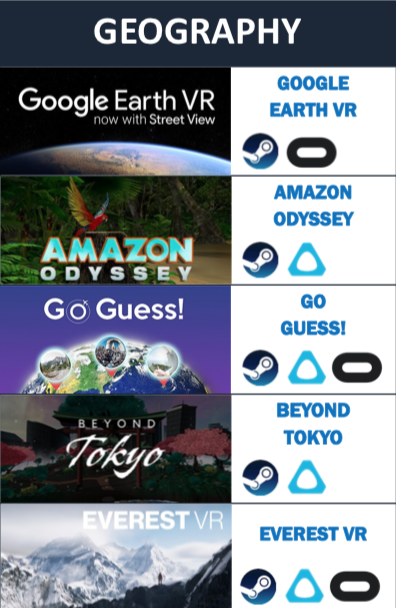
VirtualiTeach: 90 VR Education Apps for Vive, Rift and WMR - The author picked his "top 5" for each category. At right is the geography list.


Thursday, February 14, 2019

GIS Education Weekly: Meteorology, History, and Art Make Friends with Geography

Resources

Wired: Ooooh, here’s a map of all the weird sounds humans make - This is an interesting space to explore.

USGIF: USGIF Publishes Version 2.0 of its GEOINT Essential Body of Knowledge - "The EBK [pdf] is developed by conducting a cross-industry job analysis to identify the knowledge, skills, and abilities critical to the GEOINT workforce, and outlines standards for the broad practice of GEOINT."

Thursday, August 30, 2018

GIS Education Weekly: Students Make Maps for Land Trust and Rolling Stone

Resources

WaPo: The rise of Burning Man - A very nice story map-ish treatment of the spatiality of the event includes a series of satellite images showing the growth of the city before the event and its recession afterwards. (I'm not a burner, but I know about moop.)

Story Map: Mapping John Denver's 'Take Me Home Country Roads' - An introductory geography course at WVU explores the song to learn about geography. As a big fan of John Denver, marching bands, and geography, I can confirm this story map has it all. Via Allen Carroll.

Thursday, July 12, 2018

GIS Education Weekly: Esri Education Summit Highlights

Resources

Robot Development in the United States
City Lab: America’s Robot Geography - A recap of a paper in Regional Studies dives into the geography of robot development in the U.S.

USGIF: USGIF introduces its own interactive, educational map - "USGIF’s Portable Planet is a 35-by-26-foot map designed for children and teachers to walk on and explore its many features. Additionally, USGIF created cross-disciplinary, hands-on activities for educators to conduct on the map. The lessons not only teach geography, mapping, and the basics of GEOINT, but also allow students to practice skills in critical thinking, spatial analysis, teamwork, and more." Shipping and handling fees run from $200-$500 for rental.

Thursday, May 31, 2018

GIS Education Weekly: Boundless to Support USGIF Accredited GEOINT Programs

Competitions

Maps from the Overall Skills
Competition Winner's Poster
GeoTech Center: Winners of 2018 Geospatial Skills Competition - I didn't find a press release but did find this page noting the four winners and downloadable jpgs of their posters.

Esri Canada: Skills Canada GIS 2018 competition wrap up - Four teams of two tackled the challenge: analyzing the services and amenities available to seniors living in Brampton who do not drive.

Thursday, January 18, 2018

GIS Education Weekly: Many Indian Teens Can't Locate Their Home States

Education News

EdWeek: State Grades on K-12 Education: Map and Rankings - National average score is a C. The map needs improvement, too.

e-Literate: Top Hat Marketplace: What is it and should we care? - Phil Hill looks at Top Hat's pivot from classroom response system developer to content company. He includes how Demian Hommel, senior instructor of geography at Oregon State built his geography text. This is the same platform Chris Bone and Amy Lobben used for a text that embeds ArcGIS Online.

Thursday, June 8, 2017

GIS Education Weekly: A Playable Simulation of Segregation, Mapping School Safety in L.A.

via @JoelBSperanza
Resources and Articles

Education is Not Football - I like the graphic and its suggestion about multiple options for educating students. 

Parable of the Polygons - A playable simulation about neighbors and segregation based on game theory. It's spatial and raises some interesting questions.

XKCD: State Word Map - Satire. h/t @cartonerd

Thursday, September 22, 2016

GIS Education Weekly: LiDAR Course, How to Be a GeoMentor, Textbook Prices

Programs, Degrees and Courses

Temple University bought an ad sent to the AAG's SmartBrief subscribers for its residence professional science master's in GIS degree. Among the selling points: "Prepares students to become a certified Geographic Information Systems Professional (GISP)." 

Penn State offers a map of its e-education GIS alumni. It's based on Google Maps.

A bit of Penn State's Online GIS Alumni Map
NOAA's Digital Coast offers a self-paced course 80 minutes long that introduces LiDAR. "This self-paced, online training introduces several fundamental concepts of lidar and demonstrates how high-accuracy lidar-derived elevation data support natural resource and emergency management applications in the coastal zone. The material provides geospatial analysts with the information needed to understand the characteristics of lidar that have direct impacts on mapping and spatial analysis projects. A demonstration is included to show how lidar data can be downloaded from NOAA’s Digital Coast." The course requires Flash and was published in May of this year. h/t Martin Isenburg.

Thursday, August 18, 2016

GIS Education Weekly: Teaching GIS in Every School in the County; New Geo Journal, Podcast and Video Series

Degrees, Programs and Courses

The 16-month Professional Science Master’s Program in Geographic Information Science from the University of Illinois focuses on GIS and business. "'Students who come to the program benefit from high-level, cutting-edge GIS training from leading people in the field, and they also gain from the U of I’s business program, which is very highly regarded and also cutting-edge,' said Sara McLafferty, head of the Department of Geography and Geographic Information Science. 'So we think we have a very exciting combination where we've got two really strong programs that are being merged.'” The first cohort started last fall, a second one starts soon, and applications are open for the 2017 cohort. It's interesting that the program name is generic and does not mention business.

Lawrence Stipek, director of the Loudoun County, Va., Office of Mapping and Geographic Information, details the county's use of GIS over the last 30 or so years in an article at GovTech. Among the tidbits of note: "Today, GIS is taught in every county high school."

Trajectory Magazine profiles NOVA IMS, USGIF’s first international school to be accredited. That announcement was made earlier this year. The first students will graduate with a certificate in 2017.

The University of Cincinnati's Geography Graduate Student Organization and Libraries will host an organizational meeting Aug 31st to discuss the formation of a cross disciplinary Geographic Information Systems (GIS) Learning Community. Excellent!

Thursday, November 19, 2015

GIS Education Weekly: Boundless, LizardTech and NatGeo Reach Out to Educators

Trajectory Touts Northeastern's USGIF Accredited GIS Program

Trajectory is USGIF's magazine. The publication features Boston's Northeastern University and its USGIF accredited geo program in an undated article.
A private research institution, Boston-based Northeastern University emphasizes experiential learning, or the integration of the classroom with the real world by engaging students in professional internships, research, and service projects around the world. Northeastern’s graduate geographic information technology (GIT) program within the university’s College of Professional Studies has thrived under such experiential learning initiatives.
"Experiential learning" is not new at Northeastern; the school offered it when my Dad went there in the 1940s.

LizardTech offers National University Program
LizardTech, the creator of MrSID® and provider of software solutions for managing and distributing geospatial content, announced today it has made its line of geospatial software available to national university students worldwide through the new National University Subscription Program (NUSp).
This is not for U.S. institutions. Per a LizardTech representative, "This press release is intended for National Universities outside of the United States." U.S. institutions are to use the existing program detailed here.

This program, for schools outside the U.S., offers options with different numbers of seats; one is $1999 annually, the other $2999. Those are the same offerings and prices for U.S. school offerings I found on the education website. To date, LizardTech only lists schools in the U.S. that use its software including Notre Dame, USC, Youngstown State and the City of College Station, which I'm pretty sure is a city in Texas.

The company updated its educational licensing program last GIS Day.

Boundless Reaches out to Educators

On Tuesday the CEO of Boundless, @annjohnsonceo invited queries from educators:
Interested in open source geospatial software for education? Reach out to Boundless at: mailto:education@boundlessgeo.com
There was a graphic, too.


So I e-mailed. The e-mail bounced. I sent the e-mail to another Boundless address. I've not received a reply.

Thursday, September 17, 2015

GIS Education Weekly: Soil Science, What a Geo Pro Should Know, Pope Visit in 3D at Rowan

Soil Science and GIS: Great Career

Modern Farmer reports on hot careers for students based on interviews at Purdue. GIS is up there as it ties to Soil Science.
Students can focus on soil ecology, chemistry, physics, conservation, and soil landscapes—mapping the soil attributes of a certain area—among other fields of study. John Graveel, an agronomy professor and director of the Natural Resources and Environmental Science program at Purdue, says job prospects for soil scientists right now are very strong. Job opportunities include working for state and federal agencies, environmental consulting firms, and other groups, like the Nature Conservancy.
… because we’re entering an era of data-driven decision making, “the students who can position themselves to be strong from an analytical and problem-solving perspective are going to have an edge in the market.”
“Soil science students are getting some training in geographical information systems [GIS],” Graveel tells Modern Farmer in a phone interview. (GIS is a computer system that is used for collecting and displaying data as it relates to geographic points on the Earth’s surface.) “It’s hugely in demand right now by consulting firms to have people on staff who know how to do GIS.” 
Top 5 Things Every Geospatial Professional Should Know

The Disturbed Geographer, Thom Kaye, lists the Top 5 things every geospatial professional should know. I'm not sure they'd top my list but he did note they are more geared to GEOINT in a discussion on Reddit.

Subscribe!

Afraid you'll miss this important news? Subscribe to receive it via e-mail each Thursday.

Tuesday, April 3, 2012

Response: What can you do with geography?

Google posted the video below titled "What can you do with geography?" on March 28. The goal was to honor and inspire this year's competitors in the National Geography Bee and to promote geography. It's a thoughtful gesture, with snazzy Google Earth zooming, references to Hurricanes Katrina and Rita and images of treks up Mount Everest.


I'm sorry to have to say this but the video is not memorable, nor does not answer the question posed. The question was: What can you do with geography? The answer to that is a story. The answer is a specific situation, with real people, that highlights how geography matters. The video suggests geography is good and important, but in a very broad sense. Those are nice ideas and feelings, but they are not memorable nor impactful, at least not to me.

Do great news networks talk in broad, sweeping generalizations? No. They introduce you to real peopel, with real stories, to help drive home the larger issue. The recent TV production, Frozen Planet (which I have not seen) seems to hone in on specific animals, their specific stories, to drive home grander messages. NPR health stories often include a named individual who is facing a medical or insurance issue to "put a face" on a larger topic. It's both easier to follow the information and more memorable.

As I've noted before, the classic geography story is John Snow and cholera. It's both easy to follow and memorable. So, again, I beg those supporting geography to tell stories, rather than speak in broad, forgettable swaths. I'm still looking to collect more stories like that of John Snow.

Monday, October 31, 2011

The Geospatial Technology Competency Model in Plain English

I’ve gone to conference presentations and I’ve stared at the multi-colored pyramid on the Dept of Labor website, but when pigeon-holed at a conference (Thanks, Neil!) I could not recall the name, nature, or purpose of the Geospatial Technology Competency Model (GTCM). So, I did some homework. Here, in plain English is what you need to  know about the GTCM. 


1. The GTCM is one of many competency models.
The Dept of Labor has a whole bunch of models for different industries. I count 19 as write this; they range from Advanced Manufacturing (there is no basic manufacturing) to Water Sector. They all have that same pyramidal shape.
2. The GTCM defines GIS Technician workers' skills and competencies in the US.                  
Industry experts helped build it. Here’s the corresponding job description (which seems a bit dated to me based on the software products listed, but is a fine start).
3. The GTCM can be used by educators and trainers to develop course outlines and degrees/certificate programs that match these competencies.
It’s vendor and technology agnostic; that is, it's about skills, not specific software or hardware. There are some course outlines (including an open source software based one) from workshops done in 2011 by the GeoTech Center. You need a login/password to access them via a Moodle server.
4. There is a GTCM Assessment Tool.
The assessment tool is big spreadsheet that those with existing courses can use to see how their courses match the competencies. The assessment can then be used to enhance the course where there are weaknesses or confirm that topics missing in that course are covered in another course in a program.
5. The GTCM can ideally make it easier for business to hire qualified workers.
Since industry helps define the model, the argument is that schools (and other education providers) will address competencies in the model and thus graduate students who can tackle available jobs.
6. The GTCM can help in the creation of articulation agreements (agreements whereby schools accept each others credits).
For example, students who study GIS in high school may be able to transfer credit when joining a community college GIS certificate or degree program.
7. Industry organizations are beginning to use the GTCM as a basis for a variety of activities.
USGIF will be using the GTCM in its accreditation program for GEOINT (for schools, not for individuals) and GISCI is considering the addition of a competency-based examination aligned with the GTCM for its updated certification program. The GeoTech Center uses the model for a competition and URISA is looking into a management version of the model. (Source: Career One-Stop pdf)